Posts

Showing posts with the label hydraulic cylinder

HOW TO STRENGTHEN THE PERFORMANCE OF CYLINDER BARREL

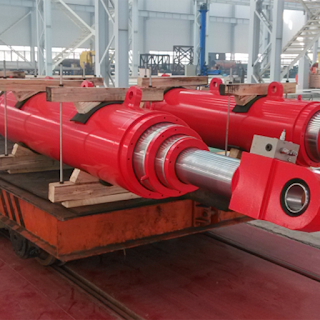
  Hydraulic cylinder  is basically composed of  cylinder barrel  and cylinder head, piston and  piston rod , sealing device and so on, if we want to strengthen its performance how to do it? 1. Using NUMERICAL control electro-hydraulic servo valve to control hydraulic cylinder can realize linear and real-time control of output, so as to improve the performance of hydraulic cylinder; 2, the cylinder has strength, can withstand dynamic working pressure, long time working without deformation; 3, stiffness, under the piston side force and installation reaction force will not bend; 4, less friction between the inner surface and guide parts and seals, can be used for a long time; 5, cylinder and flange to good welding, no cracks. 6, to correctly install the sealing device around the  hydraulic cylinder : pay attention to the installation direction when installing the sealing ring, to avoid oil leakage due to the installation, the lip should deal with the pressure ...
What is a tie rod hydraulic cylinder?

Image
  Tie rod hydraulic cylinders   are not as complex in terms of design as welded body cylinders. Tie rod hydraulic cylinders use high-strength  threaded steel rods  in order to hold the end caps to the  cylinder barrel . Small bore cylinders typically have four tie rods whereas larger bore cylinders can have as many as twenty tie rods in order to withstand the forces produced by the cylinder. Tie rod cylinders have been a go to for most agricultural applications for over 50 years. The hydraulic cylinder is used to transform the hydraulic fluid. energy into mechanical – output energy of the component. A hydraulic cylinder is a positive displacement motor of reciprocating motion. Hydraulic cylinders are widely used in the mobile and other technological industries. It’s low cost to manufacture and the fact that it isn’t welded makes it affordable for anyone needing a cylinder. Magister threaded double-acting tie rod hydraulic cylinders offer a heavy-duty design, cap...

What is a telescopic hydraulic cylinder?

Image
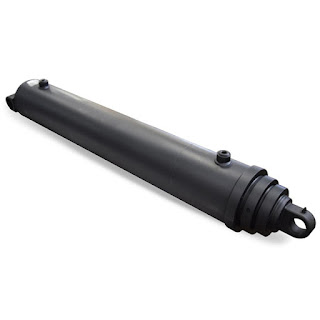
  Telescopic hydraulic cylinders , sometimes called multi-stage cylinders, are a type of linear actuator consisting of a series of tubular rods called sleeves. The sleeves (usually four or five) sequentially decrease in diameter and are nested inside of each other. Once hydraulic pressure is introduced to the cylinder, the largest sleeve (called the main or barrel) is extended first. Once the barrel has reached its maximum stroke, the next sleeve, usually referred to as a stage, begins to extend. This process continues until the cylinder reaches its last stage, called the plunger. There are two different types of telescopic hydraulic cylinders— single-acting cylinders  and double-acting cylinders. Single acting, by far the most common, work by using gravity or some other external force to retract the stages of the cylinder. As soon as pressure is released from the cylinder, the force of the load pushes oil out of the system and the cylinder retracts. While pneumatic telescopic...

How Do You Safely Remove a Damaged Hydraulic Cylinder?

Image
  The hydraulic cylinder consists of a   cylinder barrel   and a   piston rod First things first, SAFETY. Take time to inspect the machine and study the area in which you need to work. Understand the  hydraulic cylinder  system you are working on to a level where you know without question if there is any stored energy present (accumulators, heavy load on cylinders, machine parked on a hill etc), any danger that could hurt yourself or any other person. Ensure the machine you are working on is tagged out and isolated so others cannot come and start the machine while you are working on it. Once you have the machine locked out and you are certain there is no stored energy left in the lines you will need to then remove both ends that fix the  cylinder  to the piece of hydraulic equipment. Handy Hint; Be sure to remove the hoses/pipe work and plug both the cylinder ports and the hoses/pipework first.. Be sure that there is no pressure in the c...

HOW TO MEASURE A HYDRAULIC CYLINDER REPLACEMENT?

Image
  In order to measure and decide which   hydraulic cylinder   you need, first of all you would have to visually determine the type of hydraulic cylinder you try to replace. Here are the the main three types of hydraulic cylinders: Piston rod cylinder  – has piston inside, can be single and double acting (ex. Clevis cylinder) Plunger cylinder – mostly is a single acting cylinder (ex. Snow plow cylinder) Telescopic cylinder – has multiple stages, can be single and double acting Main hydraulic cylinder attributes are as follows: Bore diameter Rod diameter Retracted length Extended length Stroke Mounting ends Hose ports Working pressure Here is a detailed guide on how to properly take measurements of any plunger or piston rod hydraulic cylinder. STEP 1: Piston diameter or inside barrel diameter is the main dimension of the hydraulic cylinder and known in the hydraulic industry as “BORE”. Therefore it has to be measured first. If your cylinder is taken apart, simply measu...

What is the welded hydraulic cylinders

Image
  A  hydraulic cylinder ,is a mechanical actuator used to give linear force through a linear stroke. It can be used in a variety of ways, and is commonly seen in manufacturing machinery, civil engineering, and construction equipment. There are two main types of hydraulic cylinders: tie rod cylinders and welded hydraulic cylinders.  Tie Rod Cylinders Tie rod hydraulic cylinders are not as complex in terms of design as welded body cylinders. Tie rod hydraulic cylinders use high-strength threaded steel rods in order to hold the end caps to the cylinder barrel. Small bore cylinders typically have four tie rods whereas larger bore cylinders can have as many as twenty tie rods in order to withstand the forces produced by the cylinder. Welded Body Cylinders Welded hydraulic cylinders have no tie rods. Instead, the barrel is welded directly to the end caps and the ports are welded to the barrel. The front rod gland is generally bolted or threaded into the cylinder barrel, which a...

How To Reduce Hydraulic Cylinder Failure

Image
  Hydraulic cylinders are essential pieces of hydraulic engineering equipment. They are considered as common as pumps and motors combined, so if a hydraulic cylinder fails it can impact your entire operation. Reducing cylinder failure within hydraulic systems is important to avoid unnecessary  lengthy equipment down time. BENT RODS Bent rods are a common cause of rod seal failure. Bending of hydraulic cylinder rods can be caused by insufficient rod diameter or material strength, improper cylinder mounting arrangement or a combination of all three. Once a rod bends, excessive load is placed on the rod seal resulting in premature failure of the seal. we have the engineering expertise to calculate the permissible rod loading for cylinders in existing and new applications. BALLOONED BARREL TUBES Ballooning of c ylinder barrel tubes  is usually caused by insufficient wall thickness and/or material strength for the cylinder’s operating pressure. Once the tube balloons, the corr...

What is the stroke on a hydraulic cylinder?

Image
  The stroke of   hydraulic cylinder   is the amount of travel the   piston rod   can move in and out. It can be found by subtracting the maximum extended length of the hydraulic cylinder from it’s minimum compressed length. Generally the compressed length is given along with the stroke. To find the maximum length of the cylinder, you have to add the two together. Stroke lengths are standardized more or less in 2″ increments from 4″ to 24″, and larger increments above those lengths, such as 6″. Another standardization is that the compressed length for cylinders of any given stroke is usually the same between cylinders. For example, most cylinders with a 12″ stroke will have a 22.25″ compressed length.

What is the bore of a hydraulic cylinder?

Image
Bore is the inner diameter of the  hydraulic cylinder . The size of the bore can calculate by checking how much force is generated. Bigger the bore size can generated large force and the small one generate less force. The Bore of the Hydraulic cylinder decides the all-out intensity of the cylinder. The bigger the drag, the more it can lift or push. On the off chance that you see or hear us discussing a "4-inch" cylinder, we are continually discussing the drag of the cylinder. The outside distance across (OD) is normally around 1/2″ bigger than the drag, yet it relies upon the divider thickness, so on the off chance that you quantified your cylinder all things considered and it quantifies 4-1/2″, you can be almost certain its a 4″ Bore cylinder. Datong Hydraulic  is a professional manufacturer in producing and designing hydraulic cylinder ,besides, we also produce  honed tubes  and  chrome plated bars , if you have any inquiry about  hydraulic cylinder tube ...

WHAT IS TIE ROD CYLINDERS

Image
  Tie rod style   hydraulic cylinders   u se high strength threaded steel rods to hold the two end caps to the   cylinder barrel . This method of construction is most often seen in industrial factory applications. Small bore cylinders usually have 4 tie rods, while large bore cylinders may require as many as 16 or 20 tie rods in order to retain the end caps under the tremendous forces produced. Tie rod style cylinders can be completely disassembled for service and repair. The National Fluid Power Association (NFPA) has standardized the dimensions of hydraulic tie rod cylinders. This enables cylinders from different manufacturers to interchange within the same mountings. Tie rod cylinders are usually a bulkier design but are more often offered as standard series with short delivery times, so are more readily available. High-strength  chrome steel rods  are used, so most cylinders of this design are rated for no higher than 3,000 psi. These designs are most o...

How to deal with the scratch on the surface of hydraulic cylinder barrel

Image
As we all know,In the process of using the  hydraulic cylinder , the hydraulic cylinder barrel will be damaged,it is common that there will be scratch on the surface of the  honed tube , some customers will ignore these scratches, this to us is not responsible for the cylinder, when a small scratches in the cylinder,we usually take some tips to deal with them. 1.First,  to clean up the oil on the surface of our hydraulic cylinder barrel, then we will use the grinder machine to the surface treatment of the scratched part of our cylinder, at this time we have to grind the surface of the cylinder wall out of swallowtail groove. Although we have cleaned our cylinder at the beginning, at this time we need to clean the cylinder barrel further. At this time, we use anhydrous ethanol to clean the surface of the scratch repair of honed cylinder barrel. 2. We usually use special  repairing adhesive  to solve the scratches on the surface of  hydraulic cylinder barrel ...

Manufacturing hydraulic cylinders at Datong Hydraulic

Image
DESIGN The  hydraulic cylinders  first designed by a team of hydraulic cylinder engineers, taking into account the use of the hydraulic cylinder and the environment that it will be in. This dictates materials, coatings, seals and other specialist parts. Hydraulic systems are designed in compliance with any external legislation that relates to the industry that it is being designed for. The offshore industry in particular has a number of requirements, which Apex Hydraulics can design in compliance with.   MACHINE SHOP Once the design has been finished, the machine shop engineers start producing the cylinder. Cylinder rods and other parts are bored to minutely accurate measurements using highly specialized machinery. Cylinder rods are chromed or coated with specialist coatings company such as  Datong Group .   FITTING DEPARTMENT The fitting department puts all the components together (rod, pistons, tubes and seals). Purchasing from a wide variety of high-quality m...

Top 5 Hydraulic Cylinder Repair Tips

Image
Hydraulic cylinders  are an integral part of the hydraulic system. They are a mechanical actuator that provides the unidirectional force. Integration of hydraulic cylinders will eliminate the presence of levers and gears. Both mobile(hydraulic presses, cranes, forges, and packing machines) and industrial systems(agricultural machines, construction vehicles, marine equipment) utilize hydraulic systems. Among them, most of the application use hydraulic cylinders for lifting, picking and gripping.  Every hydraulic system will contain basic components like pumps, cylinders, valves, filters, etc.. Hydraulic cylinder is one of the least complicated components in the list. So, they are easy to repair and maintain. A person having basic knowledge about the hydraulic system can perform hydraulic cylinder repairing. Before explaining the repairing of cylinders, I will give you brief details on the causes of hydraulic cylinder failure. Damage of seals is a common reason that creates...

THE WIDE APPLICATIONS OF HYDRAULIC CYLINDER

Image
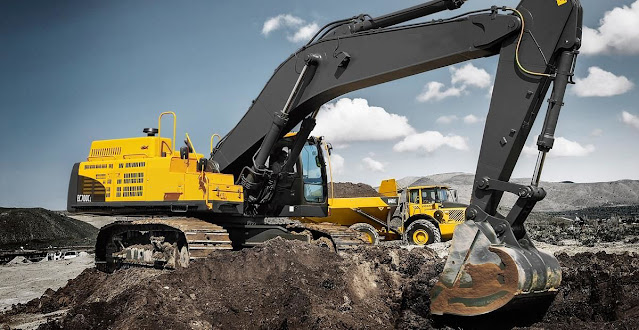
Hydraulic cylinder  is a hydraulic actuator that converts hydraulic energy into mechanical energy and performs linear reciprocating motion (or swing motion). It has a simple structure and reliable operation. When it is used to realize reciprocating motion, the reduction device can be eliminated, and there is no transmission gap, and the movement is stable, so it is widely used in hydraulic systems of various machines. The output force of the hydraulic cylinder is directly proportional to the effective area of the piston and the pressure difference on both sides; the hydraulic cylinder basically consists of a  cylinder barrel  and a cylinder head, a piston and a  piston rod , a sealing device, a buffer device and an exhaust device. The buffer device and exhaust device depend on the specific application, and other devices are necessary. Datong Hydraulic  is a professional manufacturer in hydraulic cylinder and assembly products , we have more than 23 years experie...

Requirements and material section of hydraulic cylinder barrel

Image
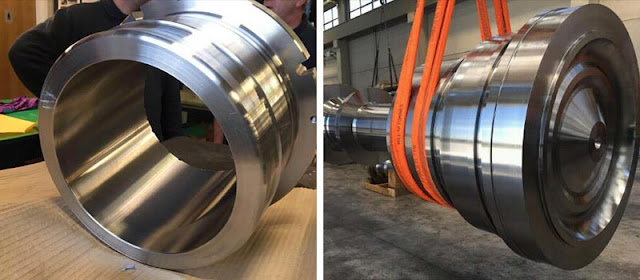
The required barrel is a key part of hydraulic cylinder , and sometimes the direct acting component of hydraulic cylinder (when piston rod or plunger is fixed); the barrel, end cover and piston (plunger) form a sealed chamber for containing pressure oil and driving the load for acting; thus the barrel has requirements for strength, rigidity and sealing as below: (1) The barrel should have sufficient strength to prevent permanent deformation under long-term rated operating pressure and short-term dynamic test pressure. (2) The barrel should have sufficient rigidity to prevent bending caused by lateral force imposed by the piston and reacting force during installation. (3) Reliable seal: The grade of dimensional tolerance and accuracy of geometric tolerance of cylinder inner surface, piston seal and supporting ring should be designed rationally to ensure reliable seal and reduce wear. (4) The cylinder barrel to be welded should have good weldability to avoid cracking or excess...

How Does Hydraulic Cylinder Work?

Image
A  hydraulic cylinder  (also called a linear hydraulic motor) is a mechanical actuator that is used to give a unidirectional force through a unidirectional stroke. It has many applications, notably in construction equipment (engineering vehicles), manufacturing machinery, and civil engineering. Hydraulic cylinders get their power from pressurized hydraulic fluid, which is typically oil. The hydraulic cylinder consists of a  cylinder barrel , in which a piston connected to a  piston rod  moves back and forth. The barrel is closed on one end by the cylinder bottom (also called the cap) and the other end by the cylinder head (also called the gland) where the piston rod comes out of the cylinder. The piston has sliding rings and seals. The piston divides the inside of the cylinder into two chambers, the bottom chamber (cap end) and the piston rod side chamber (rod end / head end). Flanges, trunnions,...