Posts
Showing posts with the label induction hardened piston rod
What is the technological difference between Case Hardening and Induction Hardening
- Get link
- X
- Other Apps
Two methods have become established for hardening workpieces in mass production: case hardening and induction hardening. A comparison of these two methods shows their differences and the advantages of each. Case Hardening vs. Induction Hardening – a Comparison If one compares the two methods for hardening steel workpieces (for a general explanation of hardening see here: Hardening), then the first striking difference is the parts handling. While case hardening processes a large number of workpieces at the same time, induction hardening focuses on the individual workpiece. With induction hardening, components are hardened workpiece . For case hardening, “batch by batch” would be a better description. Of courses, this has an impact on the manufacturing. While case hardening relies on parts logistics to carry parts between the production line and hardening, induction hardening can be integrated directly in the production line with a suitable hardening machine (e.g. MIND series) and ...
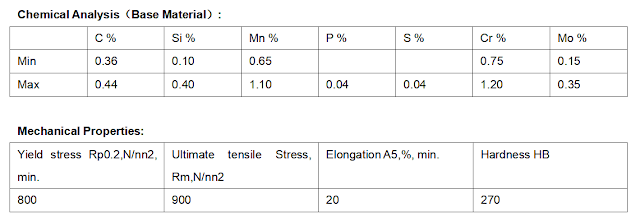
Material 42CrMo4 QT Induction Hardened Piston Rod
- Get link
- X
- Other Apps
The induction hardened piston rod is typically a hard chrome-plated piece of cold-rolled steel which attaches to the piston and extends from the cylinder through the rod-end head. In double rod-end cylinders, the actuator has a rod extending from both sides of the piston and out both ends of the barrel. The piston rod connects the hydraulic actuator to the machine component doing the work. This connection can be in the form of a machine thread or a mounting attachment. The piston rod is highly ground and polished so as to provide a reliable seal and prevent leakage. Induction hardened is a form of heat treatment in which a metal part is heated by induction heating. Induction hardened piston rods in hydraulic cylinders is performed in order to increase the resistance to damage from external impact in applications where there is risk for them. The hardness after this heat treatment is HRC 40 to 45. External Diameter Tolerance: Our chrome plated b...