Posts

Showing posts with the label hydraulic cylinder rod

HOW TO REPAIR THE HYDRAULIC CYLINDER ROD

  Hydraulic cylinders can be repaired, but you should never attempt these repairs on your own. Although hydraulic cylinders have a simple design, you must be familiar with them in order to efficiently repair them. When a technician performs hydraulic cylinder repairs, they take the entire mechanism apart and reassemble to find the root cause of the issue. COMMON POINTS OF HYDRAULIC CYLINDER FAILURE There are several common points of hydraulic cylinder failure. These include the piston, cylinder rod , seals, and head. PISTON The pistons in hydraulic cylinders are one of the most common points of failure. This is especially true in light-duty applications. The pistons used in light-duty applications are often made from aluminum, which wears out much more quickly than the steel used in heavy-duty applications. When checking pistons for failure, technicians will often measure the diameter of the piston. The piston’s diameter in relation to the bore directly affects the amount of hydra...

Datong Hydraulic/Hydraulic Cylinder Rod Chrome Thickness Testing/Hard Ch...

Image

Datong Hydraulic/CK45 Hard Chrome Plated Rod/Hydraulic Chrome Bar/Induct...

Image

The common problems of cylinder piston rod

Image
 The  cylinder piston rod  is not just the object transmitting the force from the cylinder’s piston but also the interface between that cylinder and your machine. Before you can correctly select and then design the piston rod, you must understand the potential areas of failure. The following are the top five most common piston rod problems on  hydraulic cylinders . The rod is improperly sized for the application. This can manifest in two ways, and believe it or not, a rod can be too large. Undersized piston rods have low column strength, especially in long stroke applications. A long, thin rod will bend or break when pushing loads heavier than they’re rated. Low column strength can remedy this with a larger diameter rod or a stop tube to provide added support. Conversely, if a cylinder operates in tension, an oversized rod will actually reduce retraction force. This problem occurs at the design stage, so be sure you accurately calculate retraction force with an...

WHAT IS THE BEST MATERIAL FOR HYDRAULIC CYLINDER TUBE AND ROD

Image
  An important factor that when manufacturing   hydraulic cylinder tube and rod ,the quality of steel materials.   Datong Hydraulic   work with the best materials for durable, high performance hydraulic cylinder tube and rod. Ideal properties for hydraulic cylinder materials include resistance to wear and corrosion, light weight, machinability, and low cost. Here are some of the most commonly used materials: STAINLESS STEEL TYPE 304 Type 304 Stainless is one of the most widely used materials in  hydraulic cylinder barrel  and piston rod. Type 304 Steel is not only resistant to corrosion but is also easily available and environmentally friendly. Stainless steel 304 is durable in acidic environments and does not wear easily. TITANIUM ALLOY GRADE  When used to manufacture hydraulic cylinders, titanium grade provides corrosion resistance and impeccable strength. It is also easy to machine or form, and is relatively lightweight for its strength - one of the...

what is the hardness of ck45 hydraulic cylinder rod

Image
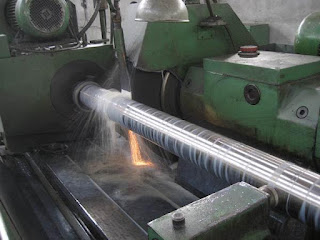
  Material of CK45   hydraulic cylinder rod   : JIS S45C / DIN CK45 / SAE 1045 and JIS S55C. By precision cold drawing, the tensile strength is higher. After harden chrome plating, the   chrome shaft   obtains good corrosion resistance, great abrasion resistance, uniformity of hardness. Piston Rod can further go through other additional processing like lathing, milling and drilling, etc. Suitable for piston rod, hydraulic cylinder rod, pneumatic cylinder shaft, punching machine, pressing machine, mechanical guide rod, mechanical column bar, solid bar, crane, plastic injection machine, sealing machine, packaging machinery, and other automation machinery. Hard chrome piston rods  processed by more than ten processing,  Precision level of f7 tolerance, surface hardness min. HV900. Chrome layer thickness 20-50micron can be choice, Salt spray test 60-90hours.  Induction hardened  hardness HRC55±2, hardened depth 0.5-3.5mm can be choice.